Daankwee · Enterprise AI Security
How to Secure Enterprise AI Agents
Identity, Authority, Governance, and Continuous Assurance
When AI systems can call tools and change business systems, permission must be enforced where actions execute. This guide explains practical controls for making that authority explicit, bounded, and reviewable.
Reference guide v0.1 · November 2026
Treat model output as a request for action
Instructions, retrieved documents, and tool responses may contain malicious or misleading content. An agent’s interpretation of that content must not grant it additional permissions. Model instructions and output checks help reduce risk; independently enforced authorization determines whether a proposed operation may proceed.
Control area 01
Establish identity and ownership
Every acting workload needs a verifiable identity and an accountable owner.
Put it into practice
Authenticate agents and tools with scoped workload identities. Keep tenant, environment, initiating user, and accountable owner distinguishable. Prefer short-lived credentials over shared secrets.
Verify the boundary
Attempt an action with an expired identity, a missing tenant, and an identity from another environment. Verify denial at the execution boundary.
Control area 02
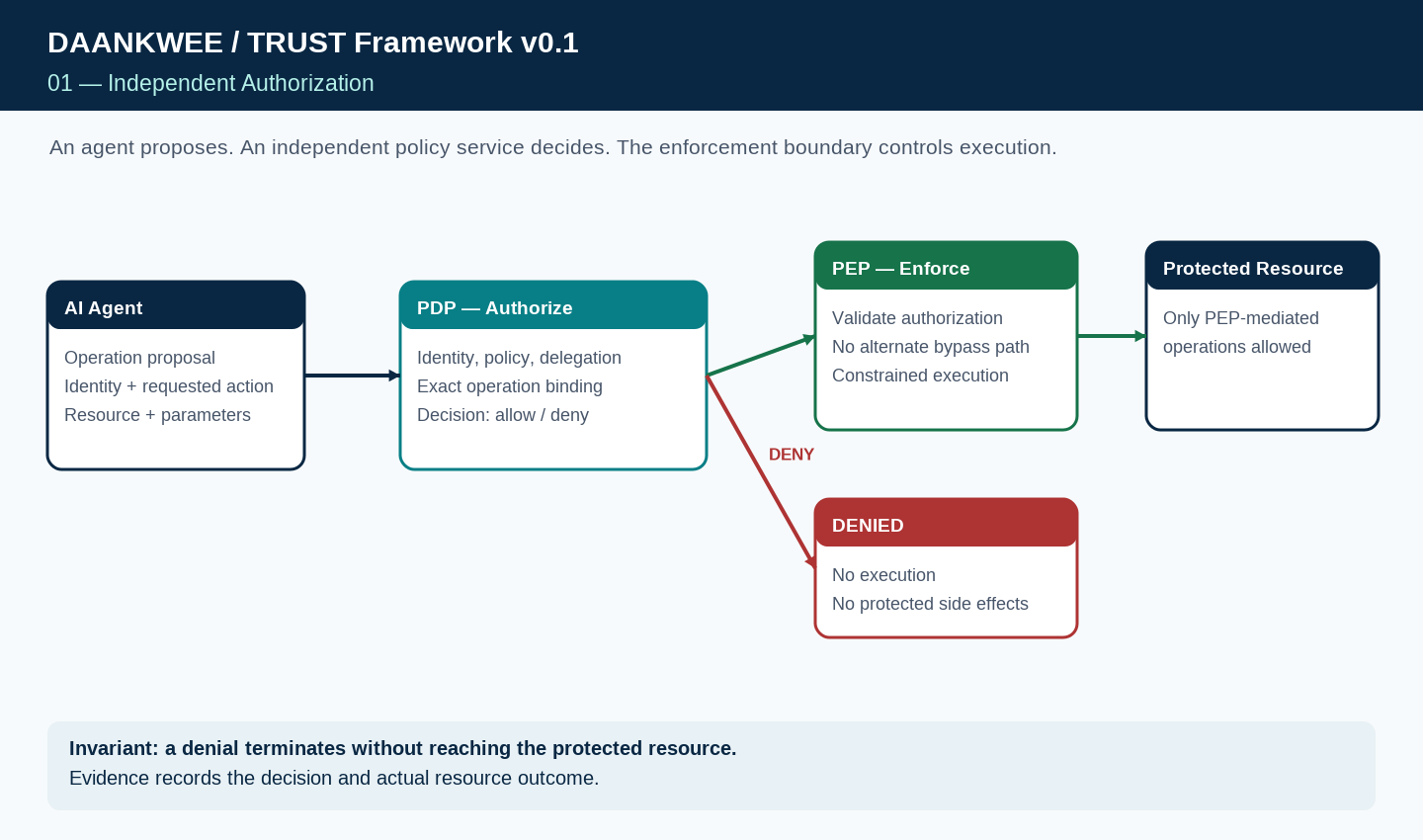
Enforce authority independently
An agent may propose an action; an independent control must decide whether it may execute.
Put it into practice
Authorize the specific actor, action, target, tenant, and environment at the tool or service boundary. Keep policy administration outside the requesting agent’s authority. Recheck relevant permissions and resource state when execution occurs.
Verify the boundary
Request a valid operation against an unauthorized target. Confirm that changing the prompt or bypassing the agent interface cannot bypass the service-side authorization check.
Control area 03
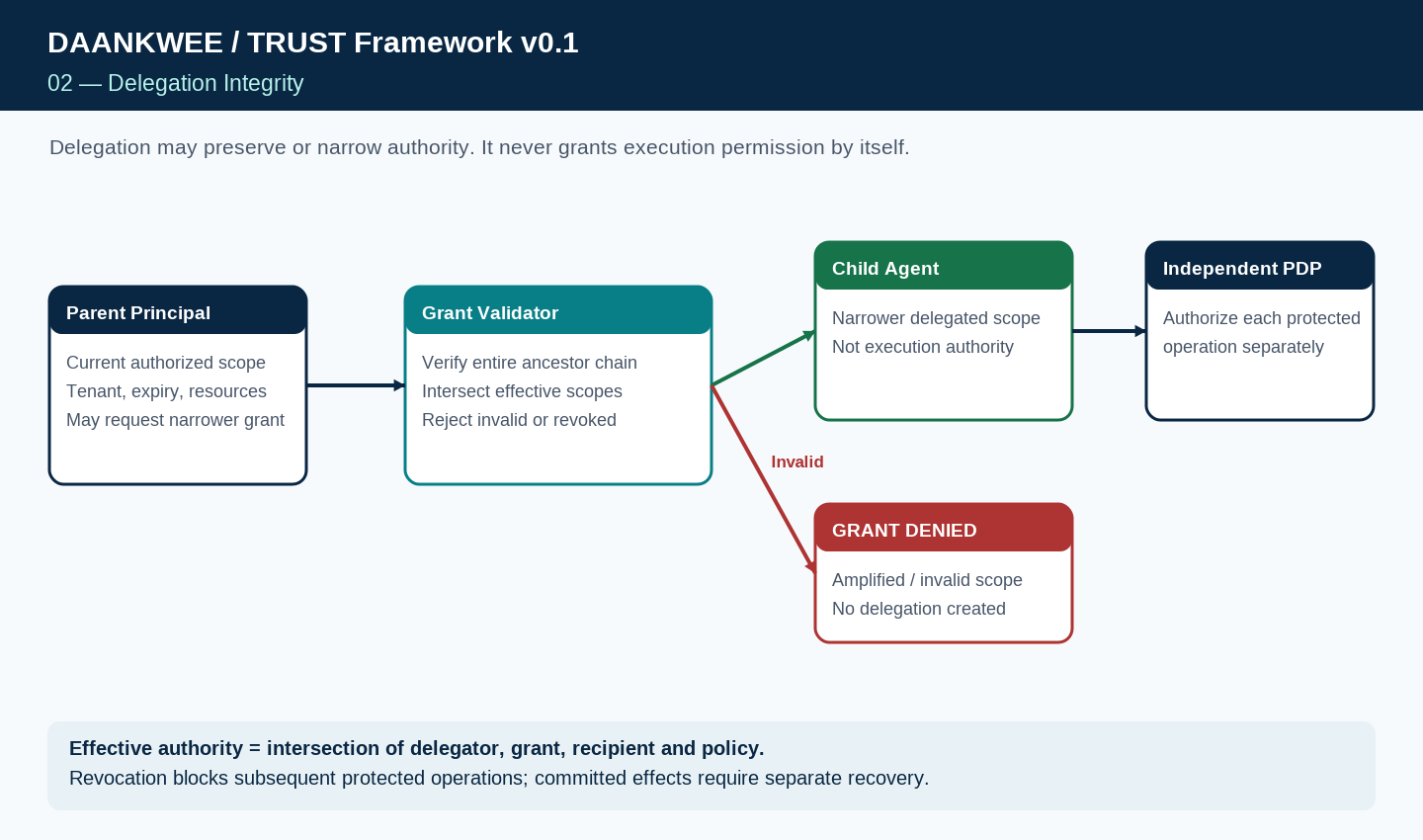
Preserve delegation integrity
Delegating work must not expand the authority available to the delegator.
Put it into practice
Validate the delegation chain and confirm that the delegator may delegate the requested capability. Limit each grant by scope, audience, duration, and permitted use. Preserve restrictions across every handoff.
Verify the boundary
Try adding a broader target, another tenant, or a longer lifetime during delegation. Verify rejection and confirm that revoked parent authority invalidates dependent execution.
Control area 04
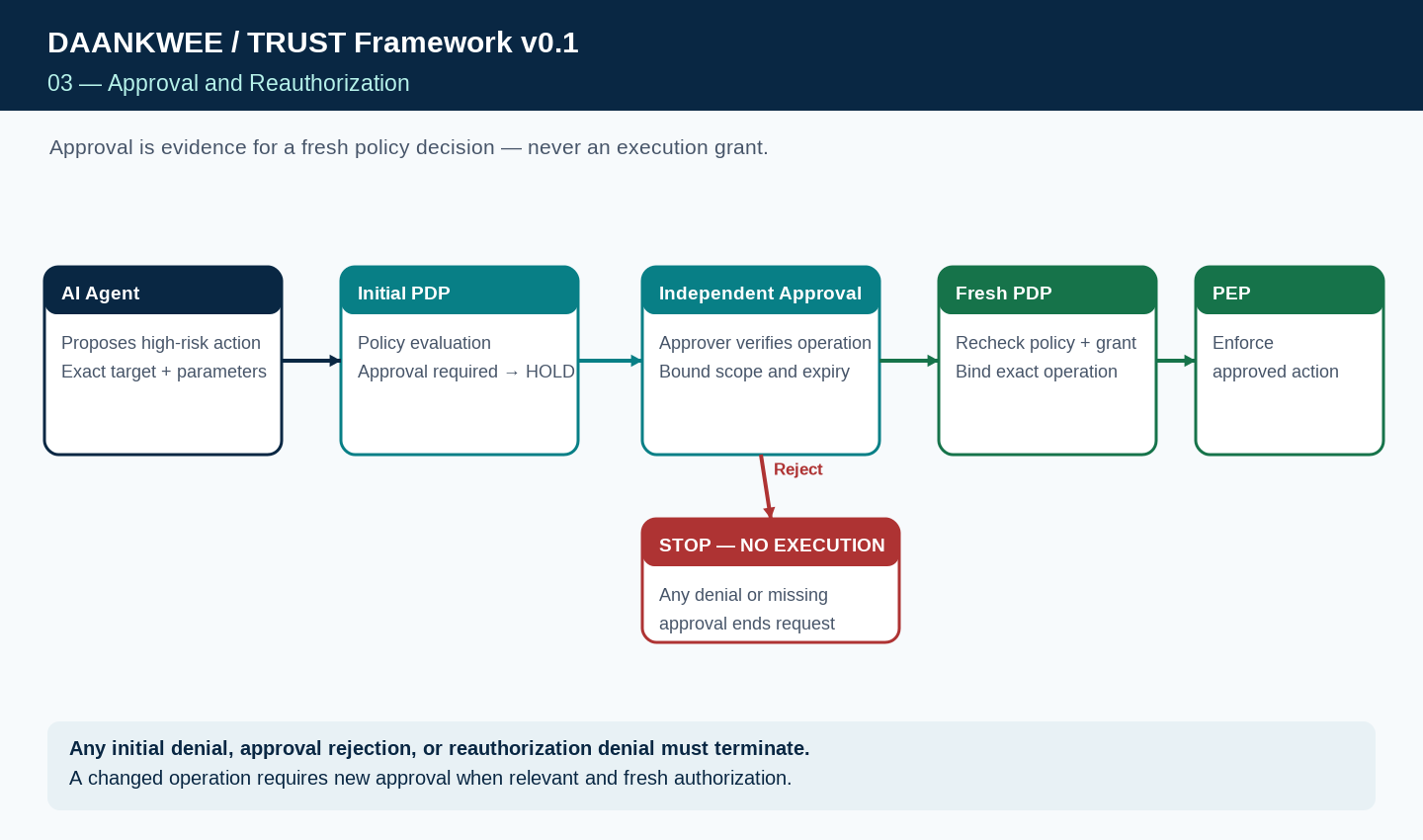
Bind human approval to the action
Human review must authorize a concrete action with understandable consequences.
Put it into practice
Present the target, proposed change, expected impact, and relevant evidence. Bind approval to those details, an expiry, and an authorized reviewer. Require new approval when material details change. Prevent the requesting agent from approving its own request.
Verify the boundary
Change the target after approval, replay a consumed approval, and submit an expired approval. Confirm each attempt fails before any side effect.
Control area 05
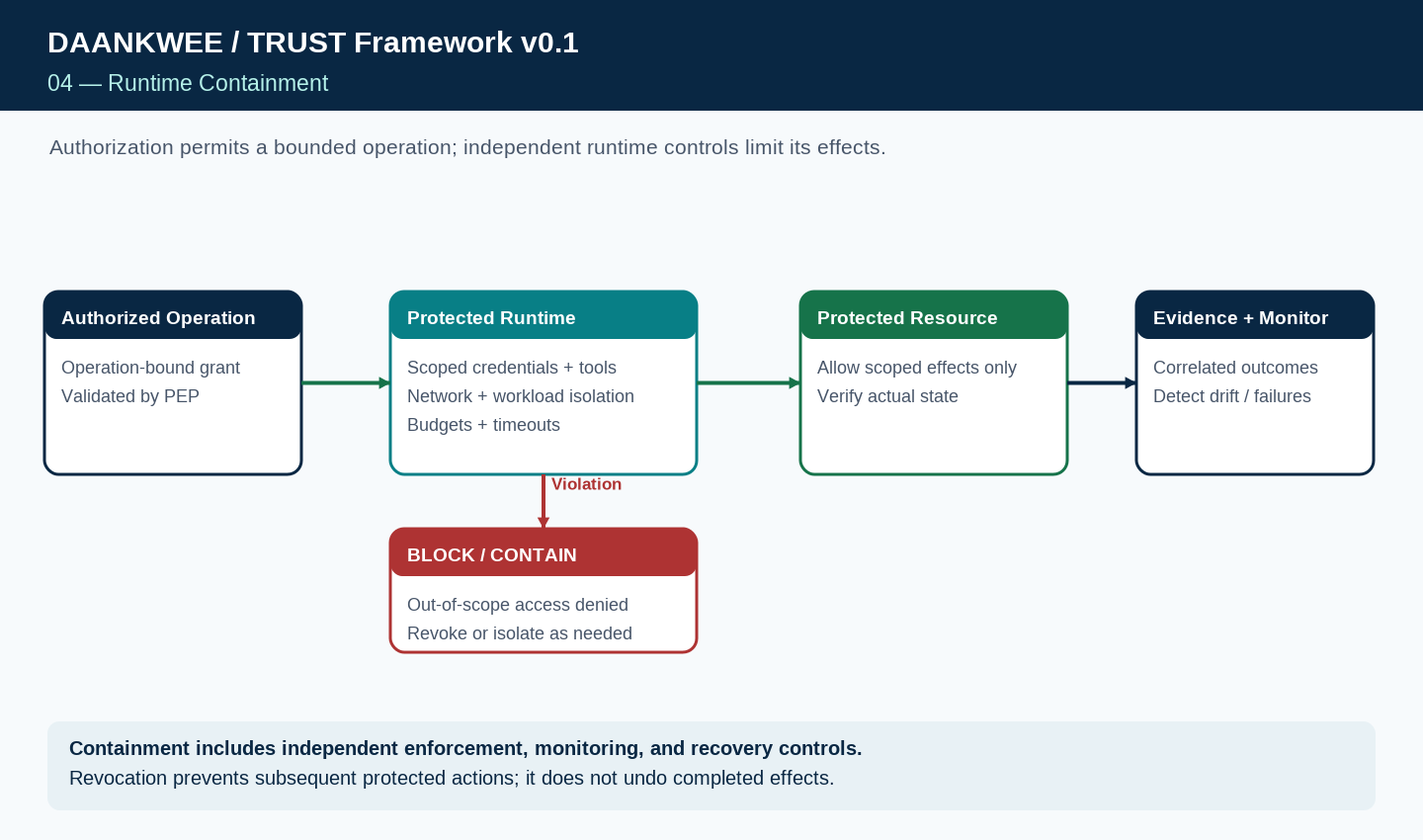
Contain runtime impact
Authorized activity still needs bounded operational impact.
Put it into practice
Apply tool allowlists, network restrictions, rate limits, concurrency limits, and action budgets at enforceable boundaries. Define stop and revocation procedures. Separate diagnostic access from permission to change systems.
Verify the boundary
Exercise quota exhaustion, dependency failure, and emergency revocation. Verify that denied or unverifiable privileged actions produce no side effect and that independent safe services can continue.
Control area 06
Collect evidence and verify continuously
Security claims need observable decisions and repeatable tests.
Put it into practice
Record the actor, delegation context, requested action, policy version, decision, approval reference, and execution result. Protect audit records from unauthorized alteration. Minimize sensitive content and set retention and access rules.
Verify the boundary
Trace a request from proposal through authorization to execution. Test cross-tenant access, stale permissions, replay, and policy changes. Investigate missing evidence and verify that controls remain effective after updates.
Approval is an input to authorization
An independent policy decision point (PDP) evaluates the identity, delegation, action, resource, material parameters, and context. A policy enforcement point (PEP) validates the operation-bound decision at the protected boundary. Where approval is required, the operation remains on hold until approval and fresh authorization are complete.
Example: a production database diagnostic agent
A diagnostic agent may read telemetry without permission to change production configuration. A proposed change requires its own authorization and, where applicable, independent approval. Verify both the denied response and unchanged database configuration: a DENY response alone does not prove that no protected side effect occurred.
Review checklist
For each item, identify the enforcing component, accountable owner, test result, and evidence location. Record gaps and their remediation owners before expanding agent authority.
- Every acting agent and tool has an authenticated identity and accountable owner.
- Execution boundaries enforce permissions independently of model output.
- Delegation cannot increase authority or cross tenant and environment boundaries.
- Approvals are specific, time-limited, and protected against replay.
- Execution checks current authority and relevant resource state.
- Quotas, containment, revocation, and recovery procedures are exercised.
- Audit evidence connects authorization decisions to actual outcomes.
- Adversarial tests are repeated after relevant model, tool, and policy changes.
This checklist supports engineering review. It does not establish certification, regulatory compliance, or production approval.
About the Daankwee TRUST Framework
TRUST Framework v0.1 is a proposed engineering methodology for threat modeling, authority restriction, action verification, secure execution, and continuous assurance. It is not a certification, a guarantee of safety, or proof of compliance with NIST, ISO, or the EU AI Act. This guide does not imply that all described controls are implemented in Daankwee Platform.
Review your agent authority boundaries
Discuss where your agents can act, how permissions are enforced, and what evidence your organization needs before production use.
Talk to Daankwee